
Coming Back, Gently: A Recovery Update and a Mindful Return
Coming Back, Gently: A Recovery Update and a Mindful Return
Written by Latosha Walker
Founder & CEO at Wondering.Waves | Military Spouse | Creator | Storyteller
Published: December 22, 2025
In this post, I’m sharing a gentle update on where I’ve been these past few weeks—recovering from a right shoulder injury, navigating pain, medication fog, and the emotional weight of uncertainty. I’m also sharing what this season has been teaching me about mindfulness, rest, and asking for help, along with a simple self-check-in practice for recovery days. Most of all, this is a quiet return—soft, honest, and hopeful—as I ease back into the blog with more Mindfulness Series posts, reviews, and life updates as I’m able.
A quiet return
There’s a particular kind of silence that happens when you don’t mean to go quiet.
Not the peaceful kind—the intentional kind where you log off, light a candle, and choose rest on purpose. I mean the other kind. The kind where you blink and realize weeks have passed, your routines have slipped out of your hands, and your own voice feels like it’s been sitting on a shelf somewhere, waiting for you to come back.
If you’ve noticed I’ve been absent from the blog for a few weeks, I just want to say thank you for your patience—and I’m sorry I disappeared without a proper word. I didn’t plan to step away like that. But I injured my right shoulder, and the pain (and the medication that came with it) pulled me into a season of recovery that required more of me than I expected.
There was brain fog. Exhaustion. A frustrating short-term memory haze that made simple tasks feel like they required a full strategy meeting. And there were days when the only truly “productive” thing I could do was follow my doctor’s instructions, rest, and let my body be the priority—even when my mind wanted to push forward like nothing had changed.
I’m sharing this gently—not to overshare, and not to turn Wondering.Waves into a medical diary—but because mindful living isn’t only about the beautiful, curated moments. Sometimes mindfulness looks like listening to your body when it interrupts your plans… and choosing compassion over performance while you find your way back.
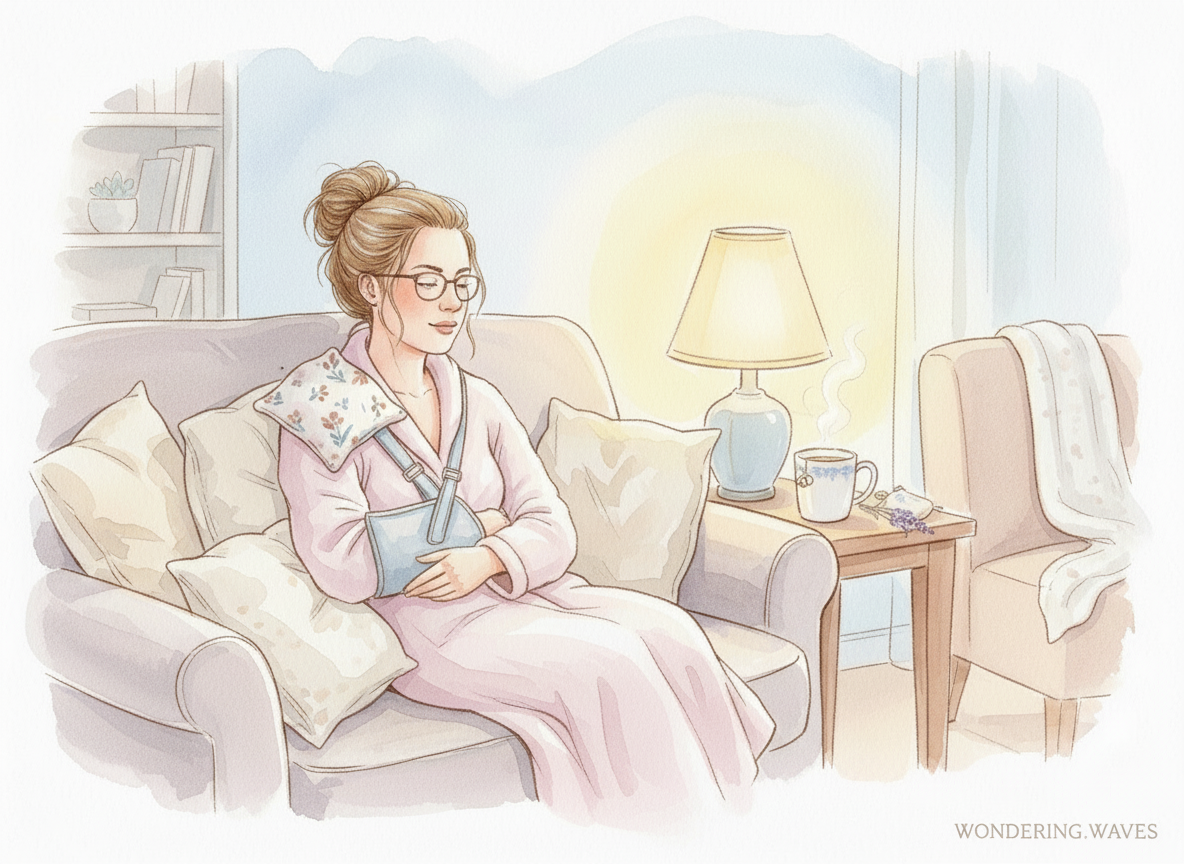
Most nights lately have been dim light, chamomile tea, my homemade lavender heating pad, and learning to let rest count as real progress. This season has been humbling—but it’s also teaching me that mindfulness can look like softness, support, and asking for help while I heal
The scene lately: dim light, warm tea, and a homemade comfort
Most nights recently have looked like this: I fall asleep hopeful—thinking maybe tonight will be the night my body lets me rest all the way through—and then, somewhere in the middle of the night, pain pulls me back to the surface.
It’s not dramatic. It’s not cinematic. It’s just… persistent. The kind of discomfort that makes you shift, then shift again, then finally accept that you’re awake now.
When that happens, I try not to fight it. I’ve learned that wrestling with pain only adds a second layer of exhaustion—the emotional kind. So I move slowly, carefully—quiet feet, soft movements—like I’m trying not to startle my own nervous system… or wake up my husband since it’s so early in the morning.
I reach for my light pink fluffy robe first—the soft one that feels like a little bit of comfort I can control. Then comes the sling. That part still feels strange sometimes, like a visual reminder that I can’t pretend my way through this. I adjust it gently, making sure everything is supported the way it’s supposed to be, and then I head downstairs to my trusty couch—the one that has quietly become my late-night recovery station.
Downstairs is different in the middle of the night. The house feels hushed and still, like it’s holding its breath. I keep the lighting low—just a dim lamp that casts a soft circle of warmth across the room. It’s enough to see without waking me up all the way. Enough to make the space feel cozy.
And then I reach for my favorite kind of comfort lately: my homemade heating pad.
I’ve been living with that thing like it’s a small, loyal companion. The funny part is that it isn’t even store-bought—it’s one I made this past summer when I was getting into sewing small things as a beginner. Cotton fabric, rice, and lavender. I designed it so it can be heated up or tossed in the freezer depending on what my body needs, and I still think that’s the coolest thing.
There’s something deeply comforting about that detail—because I made it with my own hands before I ever knew I’d need it like this. Like past-me quietly left a little care package for present-me. A reminder that softness can be practical. That comfort can be handmade. That healing doesn’t always come in big dramatic moments—sometimes it comes in small, thoughtful ones you can warm up in the microwave at 2:00 a.m.
And yes… I even time it so the microwave beep doesn’t go off. I’m standing there like it’s a tiny mission, grabbing the door with two seconds to spare—because the last thing I want is to wake up the whole house when I’m just trying to get through the night gently.
Once I’m settled on the couch, I prop myself up with pillows—one of those supportive “recovery” pillow setups I bought for myself after an emergency surgery last year. At the time it felt like a splurge, but lately it’s been worth its weight in gold. It helps me sit in a way that supports my body instead of fighting it, and honestly, it makes the couch feel less like a temporary landing spot and more like a little nest.
Then I make a cup of hot chamomile tea. Nothing fancy. Just warm, gentle, familiar. The kind of tea that doesn’t ask anything of you. The kind that feels like permission to unclench your jaw and let your shoulders drop—at least the one that’s allowed to.
And that’s what these nights have become: dim light, warm tea, lavender in the air, and me learning how to be tender with myself in the middle of the unknown. Not a cure. Not a miracle. Just a small signal to my nervous system that it’s safe to soften.
If I’m being honest, it’s also become a quiet kind of mindfulness practice—one I didn’t choose, but I’m trying to honor anyway. A slow return to my body. A gentle reminder that rest isn’t something you earn. Sometimes it’s simply what you need.
The emotional side of being “offline”
By the time the tea is steeping and the heating pad is doing its quiet little job, I usually have a moment where my mind finally catches up to what my body has already been trying to say.
Because the hardest part of this season hasn’t only been the pain. It’s been the way pain changes everything around it.
It changes how you sleep. How you move. How you plan your day. How you carry groceries. How you reach for a mug. How you sit down and stand back up. It turns ordinary life into a series of small calculations—Will this hurt? Can I do this one-handed? Is it worth the flare-up later?
And in the middle of all those calculations, I went quiet here.
I didn’t mean to. I kept telling myself, I’ll write tomorrow. But tomorrow would come and I’d realize I didn’t have the clarity to shape sentences the way I wanted. Or I’d sit down and forget what I was trying to say halfway through. Or I’d read my own draft back and feel like it didn’t sound like me—like my voice had gotten muffled under the medication fog.
There’s a specific kind of grief in that, especially when writing is one of the ways you make sense of your life.
I missed my routine. I missed the rhythm of blogging. I missed the comfort of showing up here, telling stories, and turning ordinary moments into something meaningful. And I’ll be honest—there were days I felt embarrassed by the inconsistency, even though I know better. Even though I would never judge someone else for needing time to heal.
But I also need to pause right here and give the biggest shoutout to my husband—because he is truly the hero in this story.
When I was deep in the medication fog, I couldn’t drive. I couldn’t keep up with basic things. I couldn’t do the normal day-to-day tasks that usually make me feel capable and grounded. And without hesitation, Matt stepped in and carried the weight of our home. He took care of the chores. He handled the little details. He helped take care of me in all the quiet, unglamorous ways that don’t show up on a checklist but absolutely matter.
And I will never forget him sitting with me in the urgent care waiting room for over five hours—just steady, patient, present. No complaining. No rushing me. Just being there, making the whole experience feel less scary simply because I wasn’t alone in it.
That kind of support changes everything. It doesn’t erase the pain, but it softens the edges of it. It reminds you that even when you feel “offline,” you’re still worthy of care. Still allowed to be held up. Still allowed to be human.
And that’s when I had to remind myself—sometimes out loud—that being “offline” isn’t a character flaw. It’s a signal. It’s information. It’s my body asking for space, and my brain needing time to come back online.
Military life has taught me a lot about adapting quickly, about being resilient, about figuring things out as we go. But this kind of adapting is different. This is the slow kind. The humbling kind. The kind where you don’t get to muscle through—you have to soften, adjust, and accept that your pace is going to look different for a while.
And maybe that’s why this has felt so emotional. Because it isn’t just a break from blogging. It’s a break from the version of myself that’s used to being capable on command.
If you’ve ever had a season like that—where your body or your mind forced you to slow down—please know I see you. It’s not just physical. It’s identity. It’s the strange ache of wanting to be consistent and realizing consistency sometimes has to look like rest.
Recovery is not a failure. It’s part of the work.
Somewhere in the middle of all of this, I realized I was treating recovery like an interruption—like a detour I needed to hurry through so I could get back to “real life.”
But recovery is real life.
This is where mindfulness has been meeting me lately—not in a perfect morning routine, but in the unglamorous practice of listening. Rest has been an act of mindfulness. Wearing the sling has been an act of mindfulness. Letting the laundry wait, letting emails sit, letting “normal” pause—mindfulness.
Because the truth is, healing asks for something many of us were never taught: compassion over performance.
And I’ll be honest—this has been a mindset shift for me.
I grew up in a world of swimming and physical therapy where I heard phrases like “pain is gain” and “pain is weakness leaving your body” more times than I can count. And sometimes, in certain contexts, that kind of grit can be motivating.
But I need you to know, dear friends: that statement is not always true.
Sometimes pain isn’t a challenge to conquer. Sometimes pain is information. Sometimes it’s your body saying, slow down. Pay attention. Recover. Get help.
And I’m learning there’s a difference between healthy discomfort—the kind that comes from stretching, strengthening, growing, or even the normal little aches that can come with age—and pain that persists, pain that sharpens, pain that interrupts your sleep, your movement, your ability to function.
Pain every day is not something we’re meant to normalize as “just life.” And at the same time, I also know our bodies change as we get older—sometimes there are aches that come with living in a body that has carried us through a lot.
So for me, mindfulness right now has looked like learning the difference: honoring what’s normal, and not ignoring what’s not.
And if I’m being honest, part of what made me go quiet wasn’t just the pain—it was the unknowns. The “what happens next?” questions. The possibility of surgery being on the table. The waiting. The mental tug-of-war between hoping it resolves quickly and fearing it won’t. Some days I felt brave. Other days I felt overwhelmed by how much I couldn’t control. And that’s been its own kind of mindfulness—learning to sit with uncertainty without letting it steal all the softness from my life.
I’m still in the thick of it. I’m still navigating next steps with my care team, and I’m trying to hold space for both things to be true at once: that I’m doing better than I was, and that I still don’t have every answer yet.
What I can say is this: the pain has improved because I’ve been following instructions—resting, using the sling, and doing very gentle movement only up to the point where pain begins (and not pushing beyond it). That has been its own practice.
Not forcing. Not proving. Not “powering through.”
Just listening.
And that’s the part I want to say clearly, for anyone who needs to hear it: rest and recovery are not failures. They are not the “pause button” on your life. They are part of the work. Part of the becoming. Part of the way we learn to care for ourselves like we actually matter.
If all you did today was rest, you still did something important.
A gentle reminder: don’t suffer in silence
I want to say this with care, because I know how easy it is to minimize pain—especially if you’re used to being capable, busy, and needed.
So many of us are taught to push through. To “sleep it off.” To wait until we can’t ignore it anymore. To treat pain like an inconvenience instead of a message.
And sometimes we stay quiet for reasons that make total sense in the moment. We don’t want to be dramatic. We don’t want to be a burden. We don’t want to deal with appointments, referrals, waiting rooms, and the whole exhausting process of advocating for ourselves. Sometimes we’re so used to taking care of everyone else that we forget we’re allowed to take care of ourselves, too.
But I want to offer this as a gentle, protective reminder: pain that lasts isn’t something you have to normalize. If something hurts for more than a few days—or if it’s affecting your sleep, your daily tasks, or your ability to function—please consider getting it evaluated by a professional.
Not because you’re dramatic.
Not because you’re weak.
But because your body deserves attention before pain becomes your normal.
And I want to say this plainly: asking for help is not giving up. It’s mindfulness. It’s listening. It’s choosing long-term care over short-term pretending.
Disclaimer: I am not a medical professional. This is not medical advice—just gentle encouragement to seek professional care when something doesn’t feel right.
Sometimes a simple self-check-in can help you decide if it’s time to get support:
Is this pain changing how I move through my day?
Am I avoiding normal tasks because I’m trying not to trigger it?
If a friend told me this was happening to them, would I tell them to get it checked?
Three signs it might be time to get pain checked
It’s not improving after a few days of rest (or it keeps coming back the moment you try to resume normal life).
It’s interfering with sleep—because when sleep goes, everything else gets harder.
It’s changing how you move—compensating, guarding, or avoiding normal motions to “work around” the pain.
A practical tip (especially if you’re ADHD like me)
Here’s something I’ve been practicing lately: writing things down before appointments. Because I can know exactly what I want to say at home… and then the moment I’m in the doctor’s office, it’s like all my words disappear. I freeze. I fumble. I forget the timeline. I forget the details that actually matter.
So now, I keep notes—because it’s information they need to make an informed decision, and it helps me advocate for myself clearly even when my brain feels overwhelmed.
If it helps, here’s a simple list you can jot down before a visit:
When did it start? (even a rough estimate helps)
What were you doing around the time it began? (lifting, sleeping weird, repetitive motion, stress, etc.)
Where is the pain located? (and does it move anywhere else?)
What makes it better? (rest, heat, ice, certain positions)
What makes it worse? (specific movements, time of day, certain tasks)
How is it affecting daily life? (sleep, driving, chores, work, exercise)
What have you tried so far? (and what happened when you tried it?)
Your top 1–2 questions (so you don’t leave thinking, “I forgot to ask…”)
You don’t have to be perfect. You don’t have to explain it beautifully. You just deserve support—and you deserve to be taken seriously.
Gratitude in the middle of the messy
One thing I don’t take lightly is access.
I’m deeply grateful for Matt’s military service, and for the fact that Tricare made it possible for me to seek care, get imaging, and start mapping out next steps without the kind of financial fear that stops so many people from getting help.
I know not everyone has that. And I hold that with a lot of humility.
Because I remember a time—before I was married—when I did have to choose. When medical care wasn’t just “make the appointment,” it was, Can I afford this? If I go in, what bill won’t get paid? Do I tough it out and hope it goes away? I remember what it feels like to weigh your body against your budget, and to carry pain longer than you should simply because the numbers don’t work.
So in this season, I’m grateful in a way that’s hard to put into words. I’m grateful I didn’t have to choose between paying the bills and getting help. I’m grateful we could focus on the next right step instead of spiraling into the “how are we going to afford this?” question on top of everything else.
And then there’s my husband, Matt—who has shown up for me in the most real, unglamorous, deeply loving ways.
He helped me shower. He washed and conditioned my hair when I couldn’t comfortably do it myself. He helped me stay on track with my medication when my brain felt foggy and my memory wasn’t cooperating. And he drove me everywhere—which might sound like a small thing, but in our house it’s a big shift.
I’m usually the one who drives. I love driving. It feels like freedom to me—like one of those simple everyday things that makes me feel capable and independent. And right now, because of the medication fog, I’m not driving. Not because I don’t miss it, and not because it’s easy—but because it would be selfish of me to put other people’s lives in jeopardy when I know my mind isn’t as clear as it needs to be.
So Matt has carried that piece too. Quietly. Steadily. Without making me feel guilty for needing help.
This season has reminded me that support isn’t always grand. Sometimes it’s just someone making the day feel a little more manageable—one shower, one car ride, one gentle reminder, one steady presence at a time. And letting someone help you is its own kind of strength.
A simple mindful self-check-in for recovery seasons
When my mind starts spiraling
If you’re in a season where your body is asking you to slow down, here’s a gentle practice that’s been helping me—especially at night when my mind wants to spiral into what if.
It’s simple. It takes a minute or two. And you can do it from bed, from the couch, from the floor, from anywhere you’re trying to get comfortable.
Name what’s true right now.
I’m in recovery.
I’m tired.
I’m doing what I can.
This is hard, and I’m still here.Name what you’re allowed to release for today.
I can let productivity go—and let rest be enough.
I can let the timeline be unknown.
I can let “catching up” wait.Choose one comfort cue.
Something small that tells your body, we’re safe.Offer yourself one kind sentence.
I don’t have to earn rest.
I’m allowed to need help.
Healing counts, even when it’s quiet.
Small comforts that bring me back
If you need ideas, here are a few gentle options:
Wrap up in the softest thing you own (my light pink fluffy robe has been doing the most lately).
Warm a heating pad (bonus points if it smells like lavender and feels like a tiny exhale).
Make a cup of chamomile tea and hold the mug like it’s a little anchor.
Turn on one dim lamp instead of the overhead lights.
Put your phone face-down and give yourself five quiet minutes.
It doesn’t erase the pain. It doesn’t answer every question. But it helps me come back to the present moment—the only place I can actually breathe.
And in a season like this, that matters.
Coming back, gently
I don’t have a neat ending for this season yet.
I’m still healing. Still learning what my body needs. Still taking things one day at a time—and sometimes one hour at a time. But I wanted to come back and write this anyway, because Wondering.Waves has never been about perfection. It’s always been about presence.
So this is me showing up again, gently.
Not with a big announcement. Not with a perfectly restored routine. Just with a quiet return, a warm cup of tea, and a reminder that taking care of yourself counts—even when it looks like slowing down.
And I do want you to know this: I’m coming back to the blog as I can.
I have so much to share—more of the Mindfulness Series, more local reviews, and little life updates along the way. I’ve missed writing. I’ve missed being here. And I’m genuinely excited to keep building this space with you.
But I’m also recognizing that I’m in a time of recovery. So I’m giving myself permission to return in a way that’s sustainable—slowly, honestly, and with a lot of tenderness. I may not post on the exact schedule I had before, but I amhere, and I’m not gone.
And honestly… I’ve been thinking I might turn these shoulder adventures into a little mini series of their own—something I’m calling Recovery Waves.
Because recovery really does come in waves. Some days the tide (pain) is low, and you can do a little more—you feel clearer, steadier, almost like yourself again. And other days the tide (pain) is high, and you have full permission to rest. To slow down. To let healing be the only thing on the schedule.
So if I do this mini series, I’ll create a separate category just for those updates—something you can click into whenever you want to check in, without having to scroll through everything else. You’ll be able to find it under Explore the Blog(right up in the header), so it’s easy to follow along with this specific little chapter as it unfolds.
If you’re in your own recovery season—physical, emotional, or something you can’t quite name yet—I hope you’ll let this be your permission slip to soften. To ask for help. To take yourself seriously. To stop treating pain like something you have to “earn your way through.”
And if you need a small place to start, here’s a simple journaling prompt you can borrow:
Journaling prompt:
What is my body asking for right now—and what is one small way I can honor that today?
Thank you for being here. Thank you for your patience. And thank you for letting this space be human.
Comment with me (if you feel like it)
If you’re comfortable sharing, what’s one small comfort that helps you when life feels heavy?
Have you ever had a season where your body forced you to slow down? What helped you cope?
What’s one gentle way you’ve learned to ask for help without feeling guilty?
If you could give your past self one kind sentence, what would it be?
I’ll see you soon—slowly, softly, and with more stories to share.
Latosha Walker